
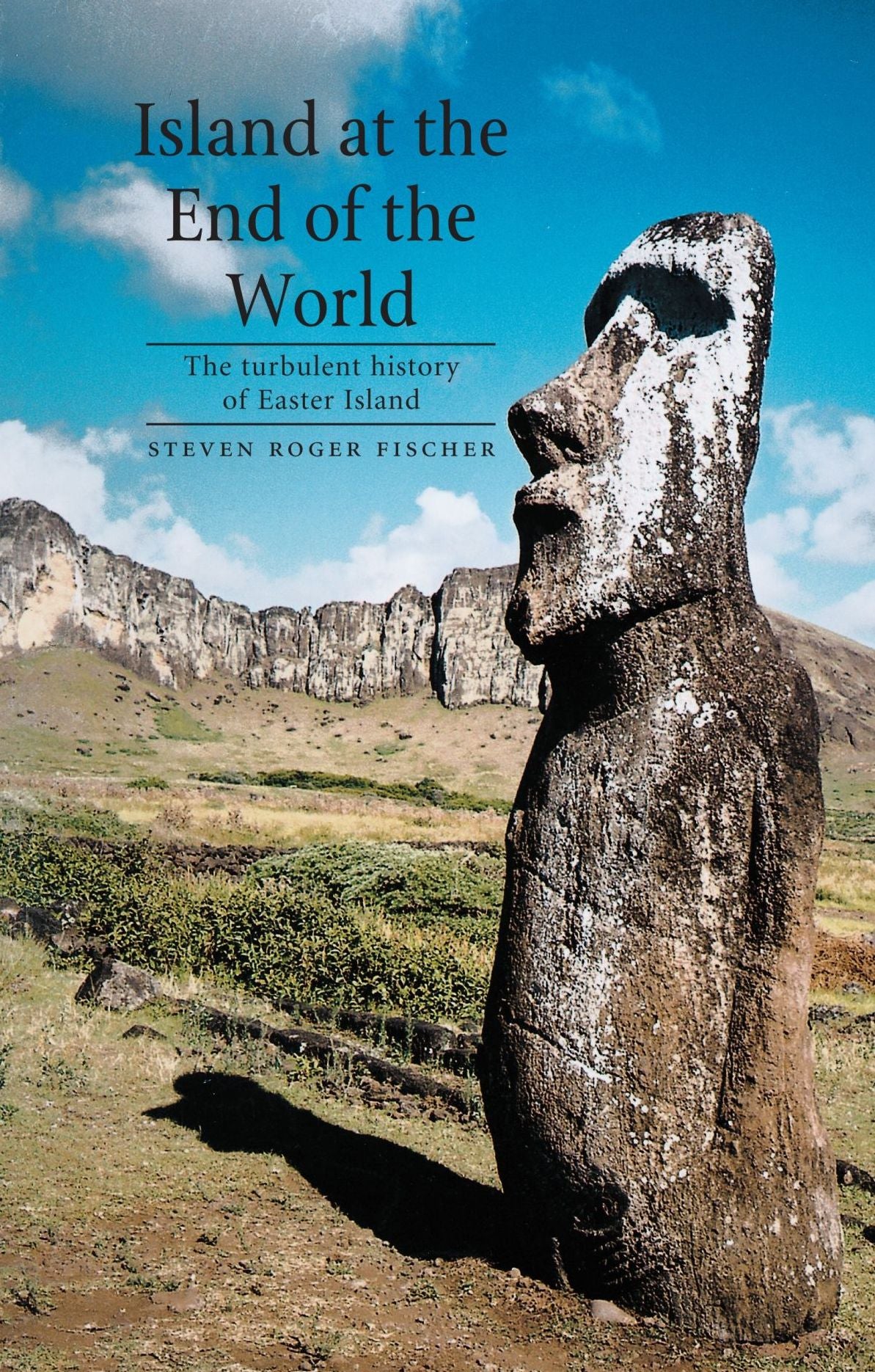
Island at the End of the World: The Turbulent History of Easter Island
Thank You For Your Reservation
You will receive an email once your order is confirmed. Items will be held for 7 days before being returned to inventory.
Island at the End of the World: The Turbulent History of Easter Island
Paperback
Prices may vary by store.
Select Store
Picking Up At:
Colfax Ave.
2526 E Colfax Avenue
303-322-7727
Store Hours:
Mon-Sat: 10-8
Colfax Ave.
2526 E Colfax Avenue,
Denver, CO 80206
303-322-7727
Store Hours:
- Mon-Sat: 10-8
- Sunday: 10-6
Aspen Grove
7301 South Santa Fe Drive,
Littleton, CO 80120
303-470-7050
Store Hours:
- Mon-Thu: 10-7
- Fri-Sat: 10-8
- Sunday: 11-6
Union Station
1701 Wynkoop Street in
Historic Lower Downtown Denver
303-535-9980
Store Hours:
- Every Day 8-8
Stanley Marketplace
2501 Dallas Street, Suite 144,
Aurora, CO 80010
212-697-3048
Store Hours:
- Every Day 10-7
After completing your reservation, you'll receive an email when your order is ready. Items will be held for 7 days before being returned to inventory. Payment will be due at pickup. By providing the information below you agree to Barnes & Noble's Privacy Policy which can be viewed here.
An error occurred while reserving your item. Please try again later.
Format: Paperback
On a long stretch of green coast in the South Pacific, hundreds of enormous, impassive stone heads stand guard against the ravages of time, war, and disease that have attempted over the centuries to conquer Easter Island. Steven Roger Fischer offers the first English-language history of Easter Island in Island at the End of the World, a fascinating chronicle of adversity, triumph, and the enduring monumentality of the island's stone guards.
A small canoe with Polynesians brought the first humans to Easter Island in 700 CE, and when boat travel in the South Pacific drastically decreased around 1500, the Easter Islanders were forced to adapt in order to survive their isolation. Adaptation, Fischer asserts, was a continuous thread in the life of Easter Island: the first European visitors, who viewed the awe-inspiring monolithic busts in 1722, set off hundreds of years of violent warfare, trade, and disease—from the smallpox, wars, and Great Death that decimated the island to the late nineteenth-century Catholic missionaries who tried to "save" it to a despotic Frenchman who declared sole claim of the island and was soon killed by the remaining 111 islanders. The rituals, leaders, and religions of the Easter Islanders evolved with all of these events, and Fischer is just as attentive to the island's cultural developments as he is to its foreign invasions.
Bringing his history into the modern era, Fischer examines the colonization and annexation of Easter Island by Chile, including the Rapanui people's push for civil rights in 1964 and 1965, by which they gained full citizenship and freedom of movement on the island. As travel to and interest in the island rapidly expand, Island at the End of the World is an essential history of this mysterious site.
Choose options
New Releases













2526 E Colfax Avenue Denver, CO

7301 S Santa Fe Drive Littleton, CO

2501 Dallas St. Suite 144 Aurora, CO

1701 Wynkoop Street Denver, CO