
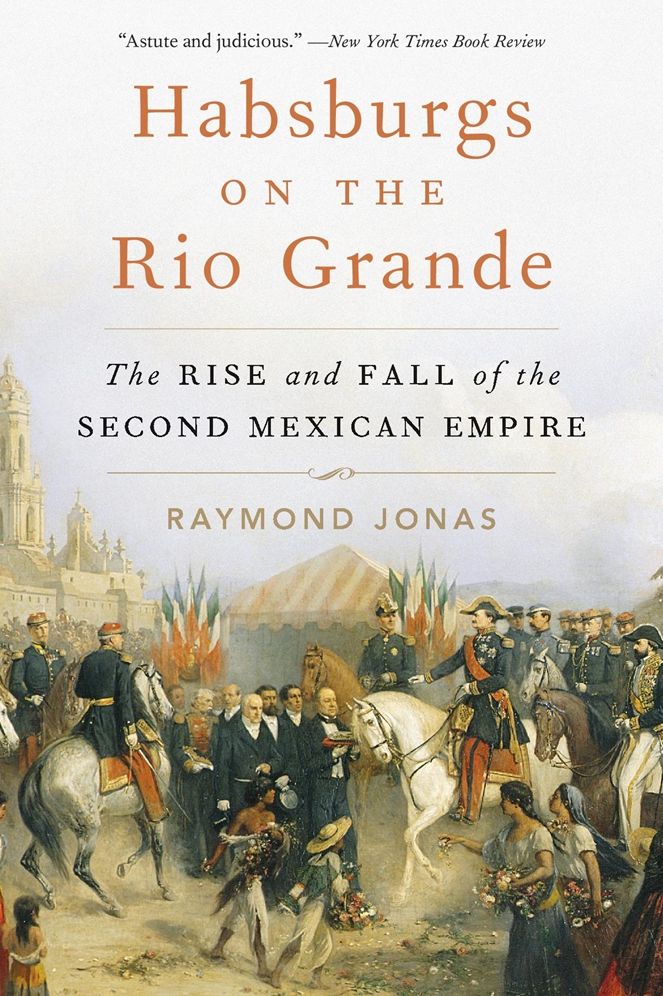
Habsburgs on the Rio Grande: The Rise and Fall of the Second Mexican Empire
Thank You For Your Reservation
You will receive an email once your order is confirmed. Items will be held for 7 days before being returned to inventory.
Habsburgs on the Rio Grande: The Rise and Fall of the Second Mexican Empire
Paperback
Prices may vary by store.
Select Store
Picking Up At:
Colfax Ave.
2526 E Colfax Avenue
303-322-7727
Store Hours:
Mon-Sat: 10-8
Colfax Ave.
2526 E Colfax Avenue,
Denver, CO 80206
303-322-7727
Store Hours:
- Mon-Sat: 10-8
- Sunday: 10-6
Aspen Grove
7301 South Santa Fe Drive,
Littleton, CO 80120
303-470-7050
Store Hours:
- Mon-Thu: 10-7
- Fri-Sat: 10-8
- Sunday: 11-6
Union Station
1701 Wynkoop Street in
Historic Lower Downtown Denver
303-535-9980
Store Hours:
- Every Day 8-8
Stanley Marketplace
2501 Dallas Street, Suite 144,
Aurora, CO 80010
212-697-3048
Store Hours:
- Every Day 10-7
After completing your reservation, you'll receive an email when your order is ready. Items will be held for 7 days before being returned to inventory. Payment will be due at pickup. By providing the information below you agree to Barnes & Noble's Privacy Policy which can be viewed here.
An error occurred while reserving your item. Please try again later.
Format: Paperback
The story of how nineteenth-century European rulers conspired with Mexican conservatives in an outlandish plan to contain the rising US colossus by establishing Old World empire on its doorstep.
The outbreak of the US Civil War provided an unexpected opportunity for political conservatives across continents. On one side were European monarchs eager to counter growing US power, which threatened their hegemony. On the other, Mexican antidemocrats needed backers to fend off the republicanism of Benito Juárez. When these two groups found each other, the Second Mexican Empire was born.
Raymond Jonas argues that the empire, often dismissed as a historical sideshow, is critical to appreciating the global effects of US power in the nineteenth century. In 1862, at the behest of Mexican reactionaries and with the initial support of Spain and Britain, Napoleon III sent French troops to Mexico. There, he installed Austrian archduke Ferdinand Maximilian as a ruler who could resist democracy in North America. But the French were routed at the Battle of Puebla, and republican guerrillas spent the next four years bleeding the would-be empire. After the Civil War, African American troops were dispatched to Mexico to hasten the French withdrawal.
Habsburgs on the Rio Grande fundamentally rewrites narratives of global history. Far from a footnote, the Second Mexican Empire was central to great-power struggles that set the terms of twentieth-century rivalry.
Choose options
New Releases













2526 E Colfax Avenue Denver, CO

7301 S Santa Fe Drive Littleton, CO

2501 Dallas St. Suite 144 Aurora, CO

1701 Wynkoop Street Denver, CO